Sept. 23, 2008

Twitter Back-Channel for the Presidential Debates on Current

If you’ve been to a conference over the last few years, you may have encountered a “back-channel”. A back-channel is simply an alternate communication channel that continues alongside the primary communications channel. For instance, there may be an IRC room where audience members can discuss a panel while the panel is going on.

For the upcoming Presidential and Vice-Presidential Debates, the channel Current is doing just that with Twitter in a project that they're calling Hack the Debate. In short, if you tweet during while you’re watching the debates, just include the tag “#current” and your tweet will be overlaid onto the broadcast (probably similar in look to subtitles or closed-captioning, but just with a lot more people contributing to the feed).

In this promo video, the Current team goes over how this might have worked if Twitter had been around for the Kennedy/Nixon debates:

I don’t know about you, but I think this sounds like it could be good fun. And while I might normally watch the debates on CNN or MSNBC, I think I’ll give Current a try. If you’d like to play along, here’s the schedule for the upcoming debates:

First presidential debate:
Friday, September 26
University of Mississippi, Oxford, MS
Vice presidential debate:
Thursday, October 2
Washington University in St. Louis, MO
Second presidential debate:
Tuesday, October 7
Belmont University, Nashville, TN
Third presidential debate:
Wednesday, October 15
Hofstra University, Hempstead, NY

That news item from the Commission on Presidential Debates goes on to say that all debates will be 90 mins in length and will start at 9 p.m. Eastern / 8 p.m. Central / 6 p.m. Pacific. And, yeah, that first one — on Friday September 26 — is this Friday.
Sept. 7, 2008

Photos from Ian and Briana’s Wedding

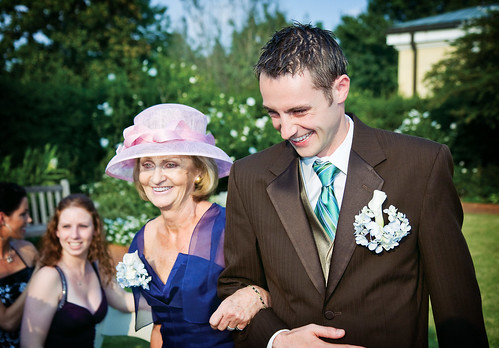
Ian and Angelika Walking Down the Aisle

My cousin Ian and his fiancée Briana got married last weekend (Labor Day weekend) in the Charlotte, North Carolina area. As it turns out, they live in the Chicago area (I believe), but they chose to have the wedding in the Charlotte area since many relatives (including Ian’s parents and my parents) live there.

Ian and Briana had their wedding at a botanical gardens in the area and it was lovely. There happened to be a 30% chance of rain on the day of the wedding, if memory serves, but it didn’t end up raining until quite later in the evening. The reception was held indoors, so the rain didn't have much of an effect on the festivities; and, even when people went outside for a smoke (or just to go outside), there also happened to be an awning around the circumference of the building.

It also so happened that this was one of the first opportunities I’ve had to make use of my Lightsphere flash diffuser. The basic idea with diffusers, if you’re not familiar with them, is that they serve to diffuse and scatter the light coming out of one’s flash in order to help reduce that portrait-in-the-headlights look that can be common to some cameras.

With the Lightsphere, like all diffusers, the enclosure attaches to the end of one's flash. On top of that, an additional strategy that’s often used — and one that I put to use — was to fire the flash upward to reflect it off the ceiling. In may sound a bit weird to fire, at first, but by firing the flash upward, the light becomes even more diffuse as it bounces off the ceiling (and then the walls and so on, a bit like billiard balls might travel across a pool table).

What ends up happening is that the light which may have formerly been harsh and direct is now much softer and generally absent of that yucky-flash look. This is all a good thing, but I can attest that it can take a little getting used-to. One adjustment (both on the part of the camera and its operator) is that the camera isn't always able to compensate for the longer distances that the light from its flash has to travel (up to the ceiling, off a wall, nothing but net and onto the subject).

Fortunately, this generally only requires a few minor adjustments to bump up the flash power; unfortunately, the operator has to remember to do so. In my case, I fell more into the latter category. Luckily, I was shooting entirely in RAW mode (well RAW+JPEG), so I had some leeway toward adjusting some of my shots that had ended up a tad underexposed as they came out of the camera. In the end, though, I was quite pleased with how things worked out. I had a great time at Ian and Briana’s wedding and the photography fun was just an added bonus.