July 13th, 2010

Photos from SXSW 2010

Andrew Huff Enjoying a Shiner

SXSW Interactive apparently had over 12,000 attendees this year, more than this year’s SXSW Music. And I still had just as much fun this year as I’ve had any year. It was great.

Once again, Grant Hutchinson helped organize a “Found Type Photowalk” around Austin. Ostensibly, it’s about typography—and there is quite a bit of typography talk—but it’s also a fantastic mid-conference respite where photographers of all types can enjoy a leisurely walk around Austin while taking shots along the way.

I brought along my trusty Canon 40D and it held up pretty well. If anything, the one thing I noticed is that even an image-stabilized lens (like the 17–55mm f/2.8 IS that I was mostly using) can’t save every shot—several of my shots during panels ended up around 1/13sec (at ISO 400) and shots that slow just don’t have a great chance of coming out sharp. (I could have theoretically bumped up the ISO to 800 or 1600, but my 2007-era doesn’t do that well at high ISOs.) Maybe I’ll consider Canon’s rumored 60D if that comes out in time for next year?

I wouldn’t be surprised if there might be even more attendees next year. And that’s okay. I’ve made so many great friends at SXSW over the years and I wouldn’t miss the chance to hang out with them again.

January 16th, 2010

Panorama from the Stars / NY Islanders Game

Panorama—Stars vs NY Islanders

Some friends and I went to the Dallas Stars game last Friday. I hadn’t been to a hockey game in a couple years and so I was rather looking forward to it. Plus, I had brought my camera along to see if I could get some shots.

It didn’t take long for me to realize that hockey can be deceptively tricky to photograph. On one hand, it’s somewhat dark inside the arena, but at the same time, longer shutter speeds can more easily blur the action. The general solution, I suppose, is just to use higher ISO settings. (I went to ISO 400, myself, but in retrospect, probably should have bumped that up to ISO 640 or even ISO 800.)

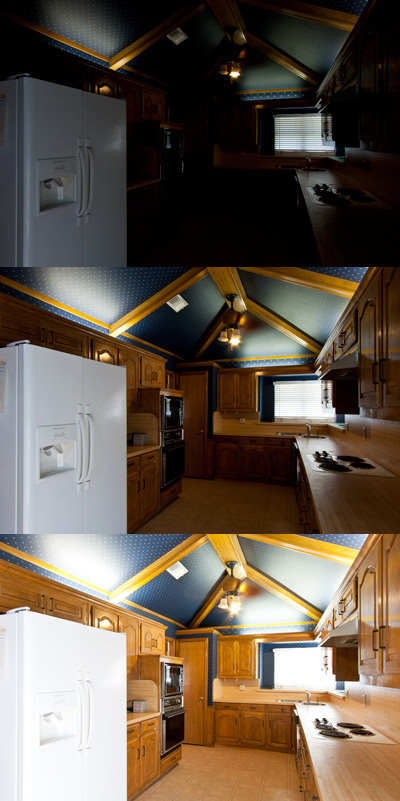
What may be the most squirrely bit about photographing hockey, though, is that the ice is really white and it can throw off one’s exposure. Most cameras judge exposure by trying to ensure that each shot has an average overall brightness of medium gray. What ends up happening in this case is that the camera sees the white ice and thinks that the shot is overexposed; so, the camera lowers exposure until the ice is back to a medium gray (which, of course, actually means that the ice is now underexposed).

To counteract these types of exposure issues, I ended up adjusting my camera’s exposure compensation to +2/3 stop; that pretty much took care of it. The shot that you see above is a panorama made from ten shots stitched together. If it helps put its dimensions in perspective, if you consider that a widescreen HDTV is 16:9, this image would be around 20:9.

January 3rd, 2010

Photos from Winterfamilytime 2009

Coffee Dad is Happy Dad

I visited my family in December and it was great seeing all of them. I hadn’t seen my brother over Thanksgiving (as he’s been living in South Africa) and it was especially good seeing him again since it had been a while since he and I last had a chance to hang out.

I grew up in Pittsburgh and it’s been several years since my parents moved to Charlotte, but I'm still getting used to the weather there (in a good way). Usually when I’d visit them in December it'd be pretty cold in Pittsburgh, with snow more often than not. In Charlotte—at least for this most recent trip—we had a few days with highs in the 50s. Rather pleasant, that.

Photo-wise, I’ve posted a baker’s dozen shots (not that I was aiming for that number—it just worked out that way). (Bonus trivia: Apparently, a baker’s dozen is also known as a Roughrider’s dozen. Who knew?) I brought along one of my new flash toys for the trip, Lumiquest's Quik Bounce reflector. What’s nice about the Quik Bounce is that it can either be configured to send all light forward or it can be configured to send 80% upward (for bouncing off the ceiling) and 20% forward.

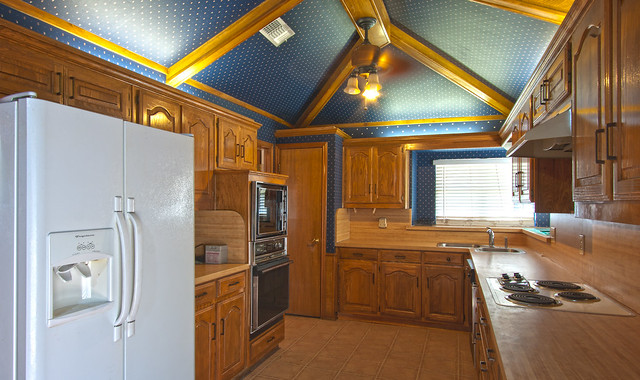
As it would happen, my parents’ family room has vaulted ceilings (while the kitchen has normal-height ceilings) and so a flash reflector/diffuser that relied upon one or the other wouldn't have really worked for me. (For instance, if I hypothetically had a Lumiquest 80-20—which is hard-coded to always send 80% upward and 80% forward—I would have been up a creek in the family room since the upward-sent light would dissipate before having a chance to bounce off the ceiling.)

With the exception of the on-the-trolley shots (like this one) and the ice-skating shots (like this one) I used a flash—predominantly fill-flash—on all the other shots in the set. Overall, I’m fairly pleased with how the Quik Bounce performed. I can see myself using the Quik Bounce again, and if anything, the one thing I’d consider changing—and this doesn’t really have anything to do with Lumiquest—might be to try setting up off-camera strobes for some of the shots. Maybe next time.

December 11th, 2009

Photos from Thanksgiving 2009

Dad and Angelika Talking

I joined my family for Thanksgiving in Charlotte, NC. Well, not my whole family—my brother Adrian has been living in South Africa since August-ish and so he wasn’t able to join us. I missed him a bit; he’s a good brother. Fortunately, I’ll be seeing him (and the rest of the fam) for Winterfamilytime later in December, so I’m looking forward to that.

My family doesn’t often have big Thanksgivings—sometimes it’d just be the four of us—but this year we had something like fourteen people. My dad’s sister Angelika’s family was all there including my cousin Ian’s new wife Brianna—uh, would that be cousin-in-law?—and some friendly neighborhood folks as well.

In my effort to try to be a good host to everyone, I ended up neglecting my photography a bit. In all, I took a few dozen shots and I’ve posted four of them. Interestingly enough, my Canon 40D’s autofocus system ended up leading my astray on one of my shots (the one with my Dad and Angelika talking, which is also featured at the top of this post).

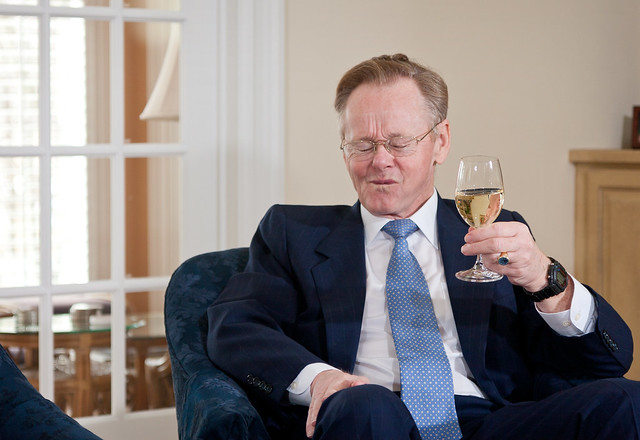
My intention at the time was to keep my Dad in focus while placing Angelika outside the depth of field. As I later found out—and this was when I was reviewing my shots on my computer screen back here in Dallas—is that Canon’s autofocus system (at least on the 40D) apparently places a focal-preference to objects that are closest to the lens (even if they aren’t the largest objects in the scene). To be fair, I’m not really blaming Canon for this; I could have (and perhaps should have) used manual autofocus-point selection to ensure the precise focal point that I had in mind.

In the end, I still kinda like the shot for some reason. Maybe it’s the canonical Dad Face that my dad has at the time. (He tends to have that look on his face when he's listening intensely to someone. It’s part of what makes him my dad.) As my friends are fond of chiding me about, I only post a fraction of the shots I take on Flickr; put another way, if I didn’t like a shot, I wouldn’t be sharing it with other people. Even though I can’t quite put a finger on it, part of me wants to be able to put a finger on what I like about it (and I can’t).

August 4th, 2009

Photos from the Rangers Game

Rangers Ballpark in Arlington

Our chum Nick hooked us up with some tickets for the Rangers game on Sunday and I took my camera along to see if I could get a few shots. The game was super fun and I think the Rangers may have even won—to be honest, as long as I get some beer in my gullet and ballpark munchies in my pie-hole, I’m almost assured to enjoy a ballgame (and this was no exception).

The one part I wasn’t quite sure about was how my shots might turn out. The game started at 7:05 p.m., I believe, and given that we we’re in Texas and it’s August, the sun was still a good ways over the horizon at this point. So, for the first hour or two, I didn’t have that many chances to take shots—the sun always ended up in the corner of my frame and was blowing out my sky. After the sun started to go down, though, the lighting situation got a bit more manageable.

During the sixth inning, I walked around to the seats behind home plate and tried my hand at a panorama from that area of the stadium. I ended up taking fifteen shots and I’m generally pleased with how it turned out. Pro Tip: If you’ve opened fifteen RAW files and you’ve just told Photoshop to stitch them all together, you may as well go get a sandwich. You may even have time to brew a cup of tea while you’re at it.

March 26th, 2009

Photos from SXSW 2009

Kevin Lawver and Alex Bischoff

I look forward to SXSW every year—it’s heaps of fun. Sure, there’s the web-stuff learning (which is good), but it’s also nice to be able to see friends again that I’ve made over the years. (For instance, that shot above is with Kevin and I—I can’t even remember how many years ago he and I had met, but it’s always good to chat with him again.)

In all, I think I took around three hundred fifty photos and I believe I’ve posted around twenty five. Last year, I had rented Canon’ 17–55 f/2.8 lens and I was really pleased with how it worked out. I just happen to have bought one a couple months ago, though, so I didn't need to rent one this time around.

My new photography gadget, though, was a Lumiquest Softbox. Unlike a traditional softbox that one might have off-camera on a light stand or the like, Lumiquest’s Softbox is designed to attach right to one’s flash. Granted, there’re about a bajillion flash diffusers/bouncers on the market (and many an online discussion thread on which one is “best”), but the reason I went with this particular product is that I was pretty sure I wouldn't have much in the way of ceilings of which to bounce off.

I’m still getting a feel for flash photography and the nuances of manual exposure toward balancing one’s ambient light with the light from one’s strobe, but I think I’m getting closer. On the other hand, I’m sometimes unsure about metering modes (evaluative/matrix, center-weighted, spot, and so on) and which ones may be most suited for flash photography.

Part of me wants to lean toward spot-metering, but on my Canon 40D, the spot metering is always done off the center focal-point (as opposed to the active focal point). I’m sure that’s messed up my exposure more than once, but I haven't quite decided if maybe I just need to learn how to use spot-metering better or if another metering mode would be more worthwhile.

In all, though, SXSW was awesome. Part of me was a little worried that it could have been even more crowded than last year, but whether through room rejiggeration or maybe scheduling tweaks, the organizers seemed to have largely taken care of some of the crowding issues that had crept in last year. Plus, this year, my brother and I had a chance to get dinner together on the Tuesday night as I was heading out (from Interactive) and he was heading in (for Music). What a great way to round things out.

January 12th, 2009

Photos from Winterfamilytime 2008

Mom Sipping Coffee

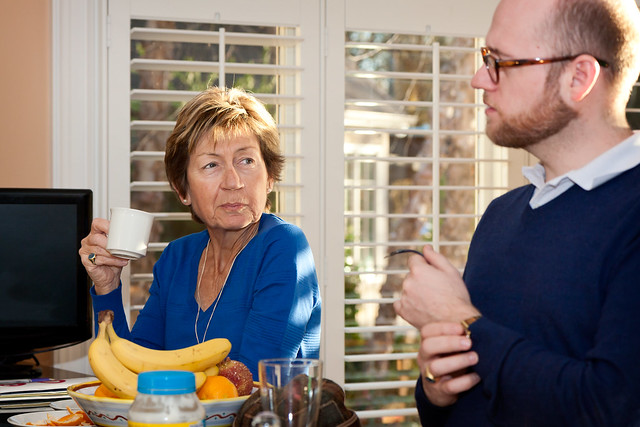
I visited my family in December, and even though it had been about a month since I had seen them last (for Thanksgiving), it was mere icing on the cake to be able to see them again in December.

Quite pleasantly, it wasn't all that cold (well, for most of the time). Sure enough, it was around 30° the first couple days, but toward the end of my stay, it did get up near 60° for a day or two. And, as it turns out, it was on one of those later days when my mom, my brother, and I decided to head into downtown Charlotte and check out a seasonal outdoor ice skating rink that my mom had heard about.

I probably hadn’t been ice skating since the dot-com bubble (back when I lived in Alexandria, VA), but my muscle memory was still mostly there—I guess it’s a bit like riding a bike in that way. Oh, what fun that was. Sure, the rink wasn’t exactly NHL regulation-size and, while not crowded, there were a fair number of people attending. I got the feeling that most of the skaters—like myself—were on vacation and so there was very little stress in the air. I had a great time and I might just have to see if I can find an ice rink somewhere here in Dallas.

My brother is also into photography he had brought his umbrella along. If you’re not familiar with photographic umbrellas, they pretty much look like regular keep-you-from-getting-wet umbrellas, except that they’re designed so that one can shoot a flash through them or, in some cases, so that one can reflect a flash off them. The gist of it is that photographic umbrellas, while not exactly small enough to carry around for casual party shots, can often create a lovely diffuse light from a flash.

It may have been the even before his flight home, but Adrian generously let me try out a few things with his umbrella. I hooked up my flash to the umbrella, a 430 EX, and after shutting each end of a length of black velour velvet in some cupboards, I took a few shots of Adrian as he coached me through some of the ins and outs. As it turns out, Adrian was a pretty good subject even through—and this isn’t his fault—I struggled even now and then at avoiding the reflection of the illuminated umbrella in his glasses.

I always knew in the back of my mind that umbrellas could help create flattering portraits, but I guess I just needed to see one in action (and with my own gear) to really believe it. I think those handful of portrait shots may have even reenergized my interest in flash-based photography. I even recently bought the Strobist Lighting Seminar DVDs (from what may be the most talked-about flash-lighting blog out there, Strobist). At $129, it’s not cheap, but with eight DVDs, the price per disc is pretty reasonable. I think I’ve watched three discs already and it’s simply a phenomenal tutorial series.

December 9th, 2008

Photos from Thanksgiving 2008

Mom Looking Over to the Grill

My family came to visit over Thanksgiving and, while my brother has hosted Thanksgiving at his place a couple times, this was the first time that I’ve hosted Thanksgiving here. My parents flew down from North Carolina and my brother came in from San Francisco. Quite pleasantly, my friend Anella was also able to join us, so in all it made for a really enjoyable Thanksgiving.

As I usually do, I kept my camera on-hand for photos. And, while I was pleased with how they came out, there were a few photo-nuances of which I made mental notes as well.

I really dig my Canon 40D and, to its credit, it does have an Auto-ISO mode (of sorts). Though it doesn’t offer settings for a shutter-speed threshold at which the ISO would be nudged upward (as Nikons do), its Auto-ISO is usually pretty competent. What I find odd, though, is that its “normal” ISO for ordinary scenes—its default ISO in Auto-ISO mode—is 400. You’d think that it’d simply choose the lowest possible ISO, and move it up from there as needed, but nooooo.

Most of my shots still worked out, and to be fair, I didn’t reject any of my shots based on ISO-grain alone. Still, if you look really closely at some of the images (at full resolution), you might be able to discern some grain there. If the shots happened to be at 1/15sec or something, that wouldn’t be so bad, but most of the shots were in the vicinity of around 1/200sec, so it’s not like the camera couldn’t have dropped the ISO to 200 and gone with a 1/100sec shutter speed. Well, c’est la vie. I suppose I’ll just have to set the ISO manually next time.

The other thing that I noticed is that my 430EX flash has no battery indicator whatsoever. More precisely, I tried to take a couple shots indoors—in the kitchen—only to find that my flash wouldn’t fire; later checking revealed that it was simply a case of the batteries not having enough juice, but it would have been nice if my flash could have told me that before I had attempted to go for those shots.

I was chatting with my chum Travis over IM today—we both happen to have flash units from Canon—and we ended up coming to the conclusion that Canon enthusiasts have little choice but to keep a spare set of batteries in his or her pocket throughout one’s flash work. Now if flash units from Nikon happen to have battery indicators, feel free to laugh at us Canon people. On the other hand, my hunch is that Nikon flash gear doesn’t have battery indicators either. I guess that’s just the way things go.

November 9th, 2008

Photos from the Quarterly Meeting

Back Row of Coworkers

The local office of company I work for, EMC, has a meeting each quarter in which the management guys go over our numbers from prior quarter (among other announcements). Some of them had been held at Dave & Busters, though most of the recent ones have been held at Studio Movie Grill. (Studio Movie Grill is a local movie theater chain that also serves food.)

The general format of the meetings is that the first hour or so is mingling time, followed by the main presentation after that. There’s also an open bar and buffet of various snacks (like pizza and cookies, just off the top of my head) and that certainly doesn’t hurt. In all, I actually find myself looking forward to these meetings a bit. The information conveyed by the presentation is part of it, but I also appreciate being able to catch-up with my coworkers. (As a consulting company, it’s not uncommon for various people to be strewn about across different client sites.)

A few days beforehand, one of my coworkers asked if I would take some pictures during the meeting. Since I enjoy taking photos anyway, I thought I’d give it a shot. I mean, how hard could it be? Well, I came to discover that Studio Movie Grill is approximately as hospitable — photographically speaking — as if I had been on the moon :-/.

You know that momentary sense of blindness you experience as you walk into a movie theater as your eyes acclimate to the darkness? Well, as luck would have it, that’s exactly how a camera sees that environment — except without the acclimation part. To make the most of the light that was there, I ended up using just about every low-light trick of which I could think:

  • I set the lens to its largest aperture, f/2.8. (I was using Canon’s 17-55 f/2.8 IS at the time.)
  • I cranked up the ISO to 1600 (which actually wasn’t as noisy as I thought it might be).
  • I also made use of my trusty flash, Canon’s 430EX.

In the end, I still had to throw away a good handful of underexposed shots (though there were also a good many that worked out). Other than what I had already tried (with the aperture, ISO, and so on), I’m not sure if there was anything else I could have done. As far as the ISO goes, I might consider ISO 3200 next time, but I’m a little uneasy about the prospect of introducing more chroma noise. The flash itself worked well, though I think there’s only so much it could do. (I suppose I could upgrade to Canon’s 580EX II, but I haven’t yet wrapped my head around how much of an improvement that may be able to offer.)

Lighting wonkiness aside, I was pleased that quite a few shots did turn out all right. Studio Movie Grill generally works out fine as venue — the seating is comfortable and the beer is always cold — but it’s just a shame that movie theaters have to be so dark inside, eh? ;)

September 7th, 2008

Photos from Ian and Briana’s Wedding

Ian and Angelika Walking Down the Aisle

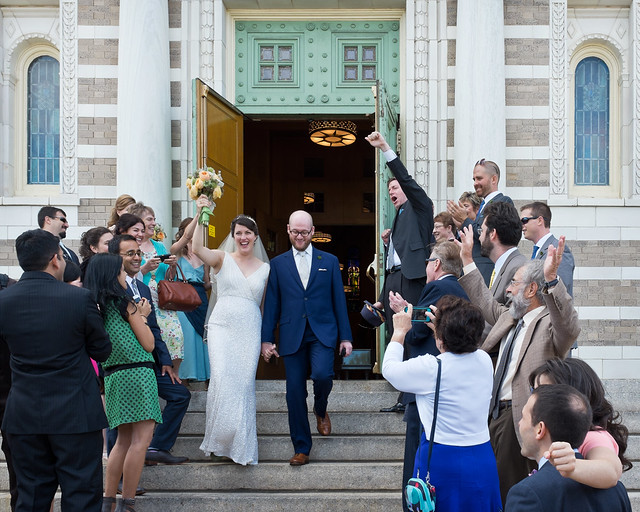
My cousin Ian and his fiancée Briana got married last weekend (Labor Day weekend) in the Charlotte, North Carolina area. As it turns out, they live in the Chicago area (I believe), but they chose to have the wedding in the Charlotte area since many relatives (including Ian’s parents and my parents) live there.

Ian and Briana had their wedding at a botanical gardens in the area and it was lovely. There happened to be a 30% chance of rain on the day of the wedding, if memory serves, but it didn’t end up raining until quite later in the evening. The reception was held indoors, so the rain didn't have much of an effect on the festivities; and, even when people went outside for a smoke (or just to go outside), there also happened to be an awning around the circumference of the building.

It also so happened that this was one of the first opportunities I’ve had to make use of my Lightsphere flash diffuser. The basic idea with diffusers, if you’re not familiar with them, is that they serve to diffuse and scatter the light coming out of one’s flash in order to help reduce that portrait-in-the-headlights look that can be common to some cameras.

With the Lightsphere, like all diffusers, the enclosure attaches to the end of one's flash. On top of that, an additional strategy that’s often used — and one that I put to use — was to fire the flash upward to reflect it off the ceiling. In may sound a bit weird to fire, at first, but by firing the flash upward, the light becomes even more diffuse as it bounces off the ceiling (and then the walls and so on, a bit like billiard balls might travel across a pool table).

What ends up happening is that the light which may have formerly been harsh and direct is now much softer and generally absent of that yucky-flash look. This is all a good thing, but I can attest that it can take a little getting used-to. One adjustment (both on the part of the camera and its operator) is that the camera isn't always able to compensate for the longer distances that the light from its flash has to travel (up to the ceiling, off a wall, nothing but net and onto the subject).

Fortunately, this generally only requires a few minor adjustments to bump up the flash power; unfortunately, the operator has to remember to do so. In my case, I fell more into the latter category. Luckily, I was shooting entirely in RAW mode (well RAW+JPEG), so I had some leeway toward adjusting some of my shots that had ended up a tad underexposed as they came out of the camera. In the end, though, I was quite pleased with how things worked out. I had a great time at Ian and Briana’s wedding and the photography fun was just an added bonus.